Comics, Crime, and Coverups
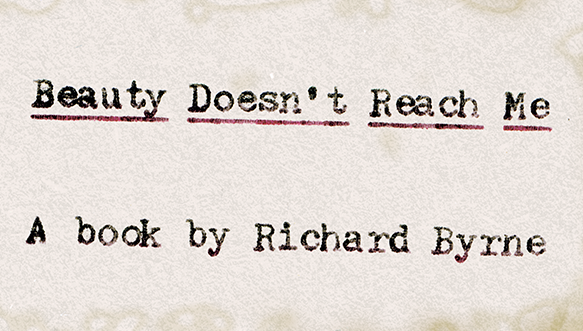
This is the second in a series of essays written to coincide with the publication of Beauty Doesn’t Reach Me (We Heard You Like Books). Order a copy now.
The mysteries surrounding Ernst Toller’s death and afterlife are numerous. Why did he commit suicide at Manhattan’s Hotel Mayflower on May 22, 1939? Why did his reputation fall into such a steep decline after his death? Why were his ashes not properly interred, but rather kept in an envelope at Ferncliff Cemetery and Mausoleum in Westchester County for almost two years?
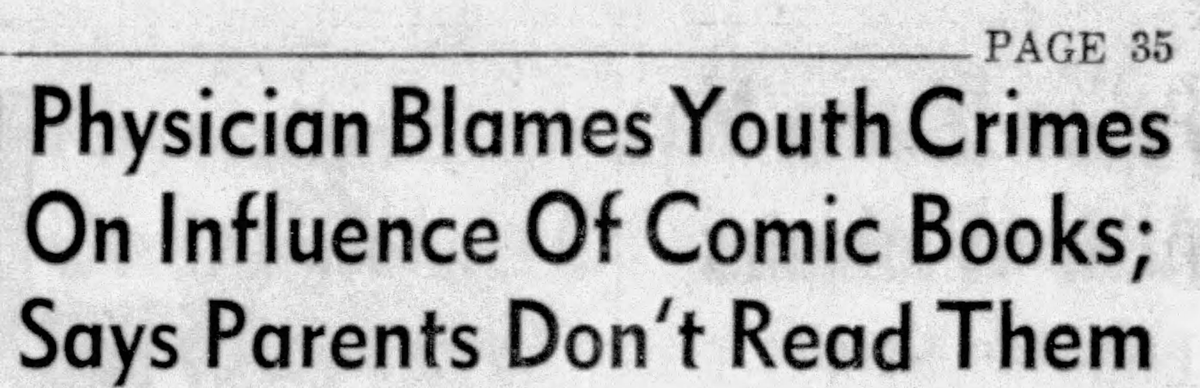
Yet the new revelations gleaned from investigating Toller’s death mask – which was made in the hours after his death – run deeper than answers about dramatist’s final days and his demise. My new book, Beauty Doesn’t Reach Me, lays out a tale of a once-mysterious object that offers a new windows into the histories of American medicine, as well as a new origin story for the anti-comic book crusade of the 1950s.
Toller’s death mask is also the site of multiple coverups. Secrets that have remained that way for almost 90 years. Beauty Doesn’t Reach Me tracks a concerted effort made across many decades not only to obscure who made the object in May 1939, but also leave open the question of how exactly it ended up in the George L. Mosse Collection at the Leo Baeck Institute.
The sculptor who made Ernst Toller’s death mask was Florence “Hesketh” Wertham. (She preferred to be know throughout her life as “Hesketh.”)
After making the mask, she pressed “Hesketh ‘39” into its orange clay.
Finding out who made the object led to an even more astonishing discovery. Hesketh was married to Fredric Wertham – one of the most prominent psychiatrists and public intellectuals in mid-century America.
In many of the great controversies of his moment, Wertham played an outsized role. He testified as an expert psychiatric witness in the espionage trials of Julius and Ethel Rosenberg, and his intervention helped Ethel win a transfer to Sing Sing prison, where Julius was being held. (He also assisted the Rosenbergs’ orphaned children after the couple were executed in 1953.) Wertham’s research also bolstered pioneering U.S. civil rights cases, including the 1954 Supreme Court decision Brown vs. Board of Education, and he was a driving force behind Harlem’s first mental health center: the Lafargue Clinic which opened in 1946.
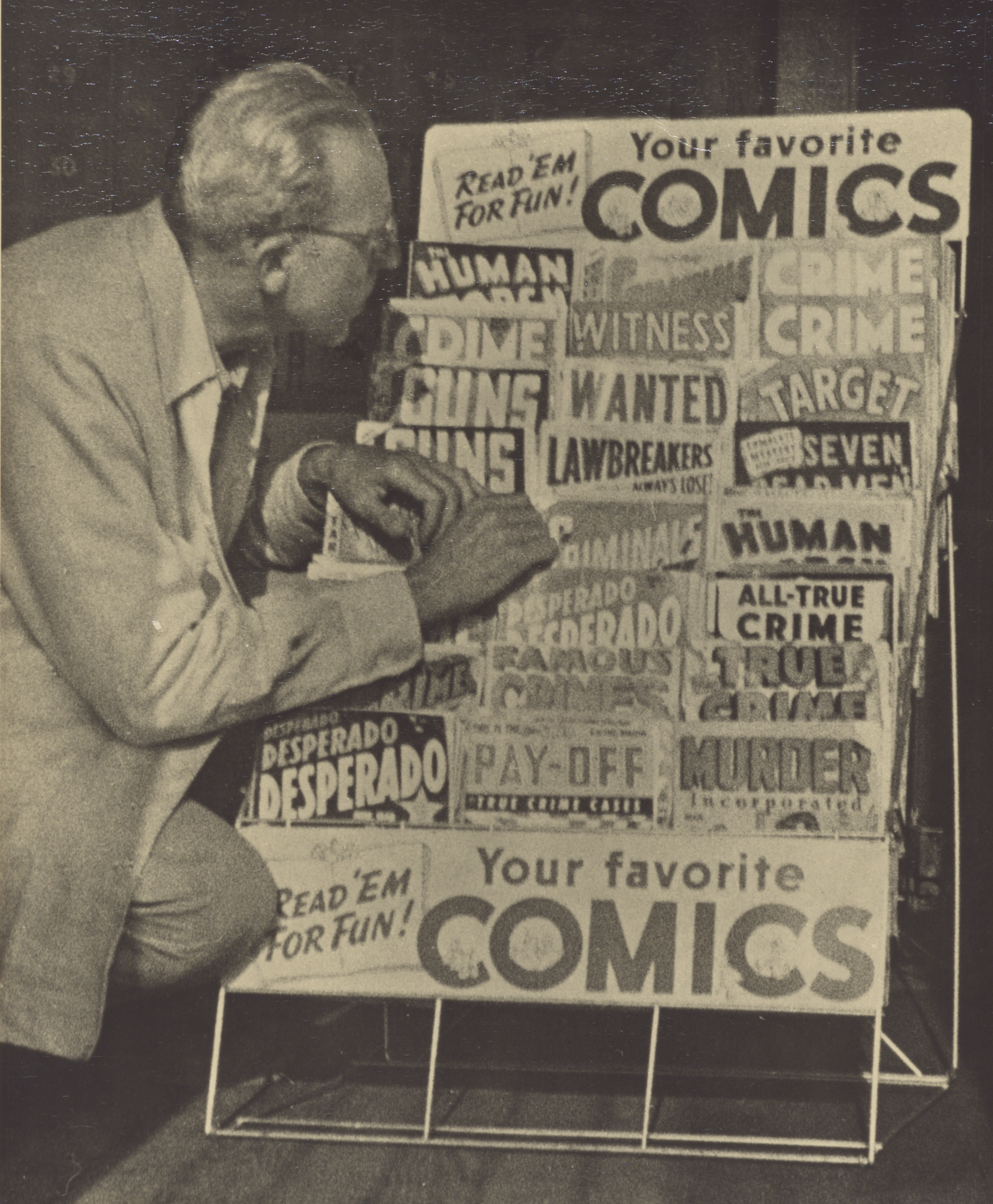
Wertham’s leading role as a fervent crusader against the pernicious effects of comic books on impressionable youth brought him even greater publicity and notoriety. His book, Seduction of the Innocent (1954), laid out his theories on the connection between comic books and a host of societal ills – including juvenile crime and illiteracy. It still raises hackles amongst comic aficionados to this day.
Scholars have been drawn to the voluminous materials about Wertham’s life and work donated by Hesketh to the Library of Congress after her death in 1987. The papers were opened to the public in 2010, and researchers have focused largely on the comic book files and the story of the Lafargue Clinic.
What I found in Wertham's papers was an invaluable new perspective on the events of May 1939. Four research files that the psychiatrist kept on Ernst Toller offer a minutely-detailed narrative about the tumultuous week after the playwright’s suicide, down to ad-hoc accounting ledgers for the funeral and orders for the printing of admittance cards to the service at Campbell’s Funeral Home on May 27.
Wertham was one of three psychiatrists consulted by Toller near the end of his life. He led the committee organizing the author's funeral. And while it is exceedingly curious that there is no mention whatsoever of the death mask made by his wife in his papers, his centrality to events gave Hesketh the access necessary to make the object in the hours after Toller’s suicide. (Time is of the essence in making a successful mask; it must be done quickly. Hesketh’s mask is a classic of the genre.)
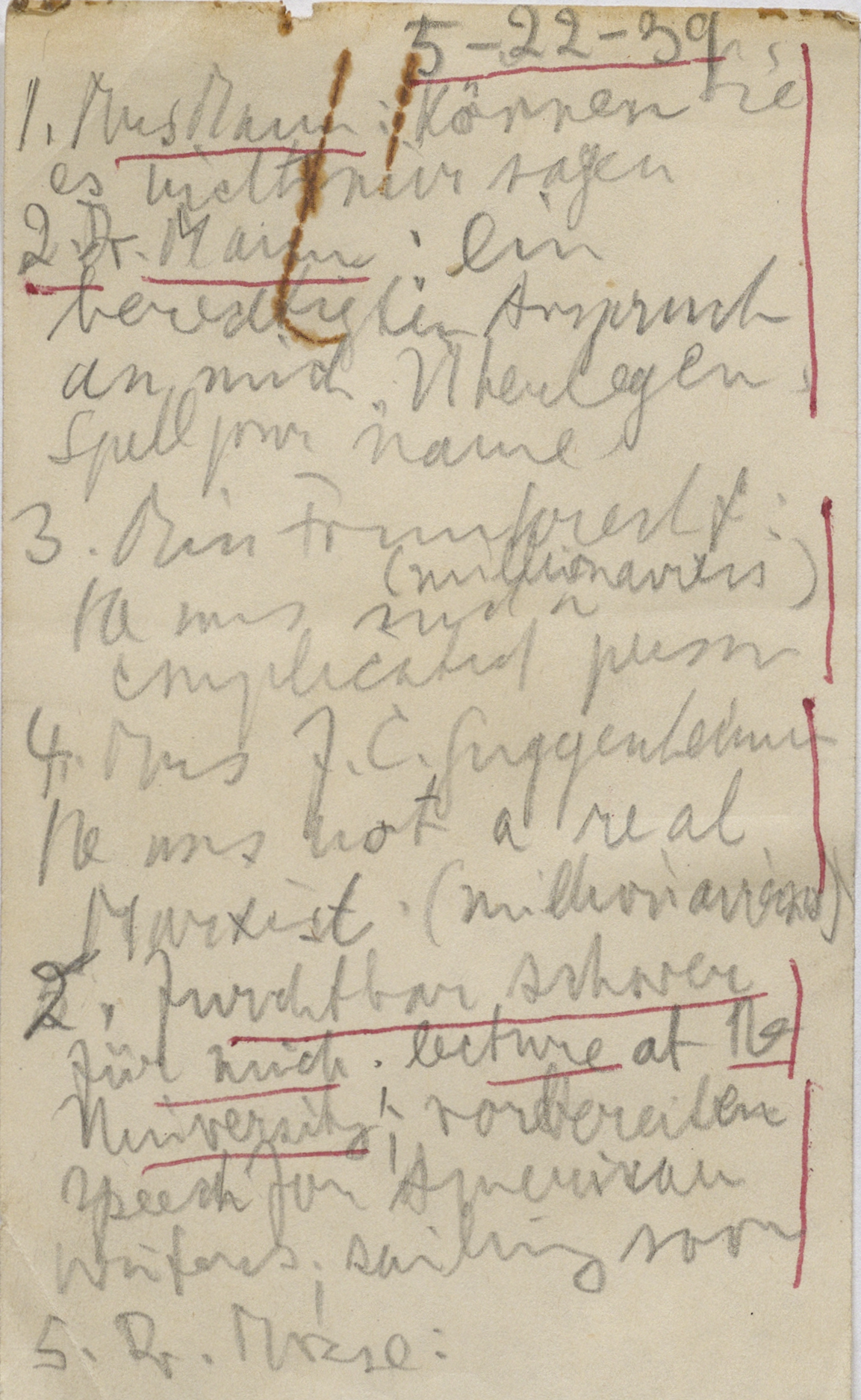
As I lay out in Beauty Doesn't Reach Me, Wertham actively curated his Toller materials into the 1970s at least. He added new items, as well as revisiting contemporaneous items recorded in pencil and adding notes and underlining in ink.
It is clear that Toller's suicide haunted Wertham – and not only in 1939. Yet he obscured his own role in the funeral committee. And when Wertham had an opportunity to set the record straight in 1974 about his roles as Toller's psychiatrist and as head of the funeral committee, it appears that he did not take it.
Quite the opposite in fact. What happened in 1939 – and his own role in those events – remained a secret until his records were made public. Indeed, confirming evidence that he was one of Toller's psychiatrists can be found only in an anecdote about an entirely unrelated incident in his unpublished memoir.
Why didn't Wertham set the record straight, even 35 years later?
One clear reason was the complex status of Hesketh's death mask, which was made without obtaining permission from Toller's widow, Christiane Grautoff. The couple were estranged at the time of the suicide, and Grautoff was working as an actress in Los Angeles. (She also did not attend the funeral.)
Grautoff was alive in 1974. There is no archival record that she ever knew of the death mask's existence, even at that late date.
Yet another even deeper secret was associated with Wertham and the death mask.
A young émigré pediatrician named Hilde Mosse arrived in New York City on November 18, 1938. She was the daughter of Hans Lachmann‑Mosse, who took over a sprawling family media empire in Germany in 1920. Her grandfather, Rudolf Mosse, founded an enterprise consisting of 130 newspapers and journals.
When the Nazis seized power in 1933, they snatched the Mosse empire away. The family scattered, including Hilde. She finished her MD at the University of Basel in 1938, and traveled almost immediately to the United States.
In the 1940s, Mosse became Fredric Wertham’s most important protégé. Her career as a physician and a researcher was woven inextricably with her mentor’s activities – including the Lafargue Clinic and Seduction of the Innocent.
Previous accounts of Mosse's life have elided any identification of when Mosse and Wertham first met – or simply posited that it must have been around the time that the Lafargue Clinic was founded in 1946.
Wertham's papers in the Library of Congress lay down a new marker: May 1939. At the bottom of his notes scribbled on the day Toller committed suicide, the psychiatrist writes: "Dr. Mosse” – an entry partially hidden by a fold in the corner of the paper. There are also two other mentions of "Dr. Mosse" in Wertham's working papers from that week.
In Beauty Doesn't Reach Me, I examine how Mosse might have come to be mentioned in Wertham's private notes that day – as well as the extraordinary steps taken to suppress her presence in the vicinity of Toller's suicide.
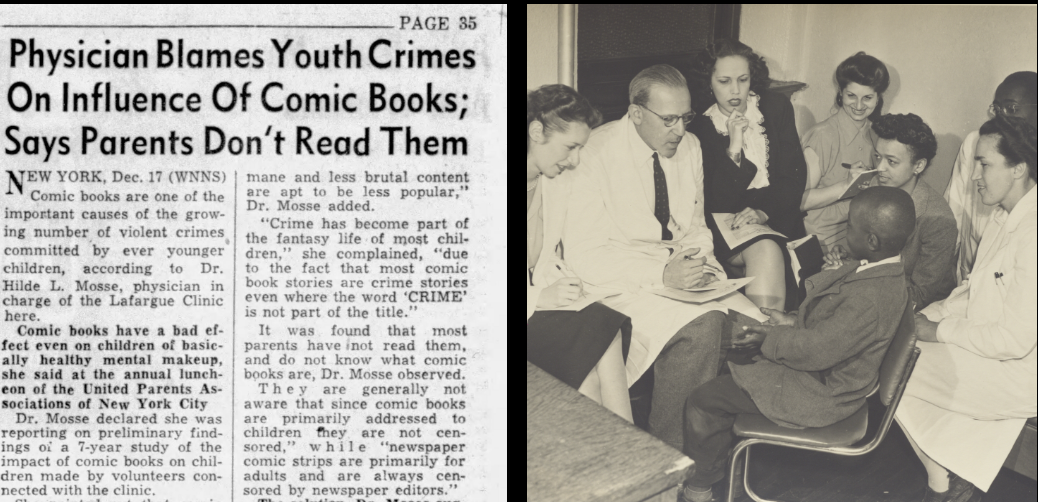
Hilde Mosse was working on the first day that the Lafargue Clinic opened in 1946. She also is the only researcher who Fredric Wertham thanked by name in Seduction of the Innocent.
Seattle‑based comics historian Leonard Rifas identified this key relationship in a 2005 paper which was published five years before Wertham's materials were made available to the public at the Library of Congress.
In “‘Especially Dr . Hilde L. Mosse’: Wertham’s research collaborator,” Rifas pointed to a close professional and ideological alignment between the two doctors based simply on a reading of published documents.
As I wrote Beauty Doesn't Reach Me, I was able to confirm that Mosse had a strong presence in both Wertham's conception and execution of Seduction of the Innocent by examining the Library of Congress materials. I also found an abundance of evidence that their concerns about child welfare, mental health, institutional racism, literacy and delinquency were not at all separate streams, but a strong unified current fed by different streams.
My research in the Library of Congress and other archives confirmed another essential element of the story via tangible evidence of a deep personal friendship between Mosse, Wertham and Hesketh in the 1950s and 1960s.
Assembling the bits of information scattered through multiple archives offered new paths into the murkiness that surrounds Toller's death, as well as the intellectual foundations and personal connections that sparked the broader anti-comic book movement in the postwar years.
It also brought some more clarity to the questions of how and why Toller's death mask can be found today as a unique and riveting object in the Leo Baeck Institute's George L. Mosse collection.
Check out my personal website and the We Heard You Like Books website for more information, including how you can buy Beauty Doesn’t Reach Me.
Not a subscriber to Stage Write? Sign up here. It's free – and it will stay that way.