The Post-Presidential Havel

In September 2010, I spent a good deal of time in Prague visiting places associated with Czech playwright, dissident and President Václav Havel – who would have been 90 today. Indeed, I was fortunate enough to see Havel up close on this visit as I had coffee in the tiny café at Divadlo na zabradli ("Theatre on the Balustrade") – the small playhouse near the Vltava River where Havel started his career and found fame as a writer.
Looking dapper in a suit and tie, Havel had arrived to do a television interview at the theatre. He walked through the café with a wry smile and a slight stoop, nodding to patrons (including me) and exchanging greetings with us as he made his way into the theatre’s lobby.
After I returned to the United States, I wrote piece on Havel and politics and his return to playwriting that I posted on my former blog: Balkans via Bohemia.
I have reworked it a bit in 2026 and post it again here on this notable occasion.
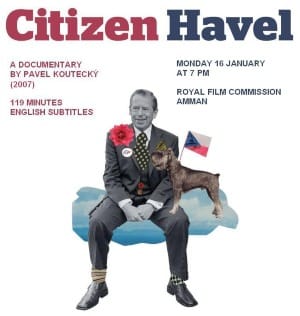
“Being in power makes me permanently suspicious of myself.” – Václav Havel
The Prague castle is the city’s crowning glory, as well as its classic postcard image. Hapsburg emperors ruled by fiat from its imposing perch above the town. Totalitarians – both fascist and communist – also governed by terror from its heights.
So when revolution swept through Czechoslovakia and elsewhere in 1989, it was in Prague castle that Václav Havel, the nation’s most prominent –and oft-jailed – dissident, was installed as president. Crowds chanted a three word slogan: “Havel na hrad” (“Havel to the castle”).
In a 2002 speech at CUNY, Havel himself called the story of his rise from censored playwright to imprisoned dissident to president in a castle a “fairy tale.” But in that same speech, published in the New York Review of Books as “A Farewell to Politics,” Havel also spoke of the “hard fall to earth” involved in governing.
Yet Havel used the occasion to reflect upon his legacy, as well as the opportunities that leaving politics might offer to him to regain some of that lost magic. “I cannot help feeling that at the end of my long fall from a fairy-tale world onto the hard earth,” said Havel, “I suddenly find myself once more inside a fairy tale.”
So what did Havel do in the new fairy tale that ended with his death on December 18, 2011? I thought a lot about this question on a 2010 trip to Prague, poking into various haunts associated with Havel and visiting his presidential library in Old Town Prague.
Freed from self-suspicion, Havel spent as much or more time in his post- presidency revitalizing the activities of dissidence and drama that launched him to power as he did engaging in the usual tasks of an ex-presidency: burnishing his legacy and offering self-justifications.
Whether it was writing a new play and a presidential memoir that trafficked in the political absurdism of his early work or making efforts to export the success of his mix of human rights and civil disobedience beyond Eastern Europe, Havel did something more honest than recapture a fairy tale. He found innovative ways not only to recount the fall, but also sow the seeds that might sprout new Havels elsewhere in the world.

In the warm glow of international acclaim, it’s easy to forget that Havel’s domestic profile shrank greatly after thirteen years in office. He left Prague Castle to indifference from many quarters, as well as jeers about his personal peccadilloes from critics. Mutual exasperation and exhaustion between Havel and his countrymen muted his departure, and his leavetaking was soured further by the signal indignity of his longtime antagonist Vaclav Klaus being installed as his successor.
There were failures as well as successes in his term as president. Havel presided over the break-up of Czechoslovakia into two nations (a move he opposed but did not effectively combat). He then served two terms as president of a newly-created Czech Republic, during which his greatest accomplishments were cementing the new state successfully into NATO and the European Union.
Havel's political career did seem to leave his playwriting career in the shadows. So it is useful now to recall his beginnings as a playwright, as well how his literary work came into confluence with his burgeoning profile as an activist in the late 1960s and 1970s and 1980s.
Havel’s early plays siphoned energy and inspiration from earlier playwrights of the absurd such as Eugene Ionesco and Jean Genet, but his genius as a playwright was to bend the genre to his own political uses by pitting the individual against the totalitarian state.
In his breakthrough play The Garden Party (1963), young Hugo Pludek’s joyous entanglement with and rapid rise within a soulless bureaucracy of “liquidation” and “inauguration” leaves him so completely effaced that his own family does not recognize him at the end of the play. His next play, The Memorandum (1965), uses the machinations of ambitious rivals of a slightly oblivious director in a large enterprise to fashion a parable about the nonsensical fantasia of bureaucracy. As these rivals outmaneuver the director (and then, ultimately, themselves) by introducing a nonsense language for corporate communications, the audience is given justice and futility. Philosophy in the theatre has never been so satisfying.
What made Havel’s early plays so striking – as I alluded to above – was their transmutation of the theatre of the absurd into a rhetorical scalpel, cutting cleanly and sharply through the communist state. The individuals in these plays are dehumanized by not by the absurdity of existence, but rather the inhuman and absurd demands of the state. The state can make such irrational and absurd metaphysical demands on humanity because it has the absolute power to do so.
The Soviet invasion of Czechoslovakia in 1968 drove Havel into the active dissidence for which he is still best known. Havel’s playwriting was transformed as well – from the comic assault against totalitarianism and party hackery of his early work into plays that starkly and simply evoked the pitched moral battles of dissidence.
The three Vaněk plays (Audience, Unveiling and Protest) are the best-known of these dramas. The ironic distance of the early work is erased, and the character of Vaněk (a stand-in for the author himself, with wrinkles and creases and self-critique) forcibly confronts the psychology of collaboration – and its infection of every element of society – workplace, social life, friendship.
Much of Havel’s work written in the few years before the Velvet Revolution was a synthesis of two earlier styles. Temptation and Redevelopment (the best known of these plays) revisit the absurdities of totalitarian life and its warping of reality that were the engine of his earlier work, yet they manage to frame these conflicts in the more starkly moral terms of the Vaněk plays– to the point of retelling the Faust legend in Temptation. These are plays of great complexity and humanity which have yet to receive their due.
Havel’s plunge into outright political dissidence after the violent repression of the Prague Spring – and his repeated incarcerations by the Czechoslovak state – reduced his theatrical output and yielded the great political essays and correspondence ("The Power of the Powerless," Letters to Olga) that made his name as a philosopher and political thinker.
Then, Havel’s fairy tale ascent to the presidencies – first of Czechoslovakia, and then of the newly-created Czech Republic – almost completely channeled his literary output into speechmaking and other political writing.
At this point, his fierce jousts with Václav Klaus over the nature of the post-communist state not only wore down Havel, but also dragged him into the muck and mire of modern quotidian politics – including the requisite manufactured scandals. As a young writer and teacher of ESL in Prague and its environs in 1991 and 1992, it was impossible for me not to see the emergence of what would be a grim two-decade struggle between the two men.
Havel’s intellectual brilliance and moral courage in the 20 years leading up to 1989 was a magnet that attracted the wide range of support needed to wage a peaceful and successful revolution. But those skills were not the ones required in the immediate aftermath of the revolution he helped to create.
Rather, it was Klaus who seized that post-revolutionary moment, organizing his political party (ODS, or Občanská demokratická strana) and creating a politics of faction: first in helping, with the connivance of Slovak politicians, to end the joint Czechoslovak state, and then in polarizing the Czech electorate with his intransigent crusade to install free market radicalism in the formerly socialist state.
Klaus’ message had fertile soil in post-communism, and many of the students in the little petrochemical town north of Prague where I taught English were involved in the grassroots party efforts that Klaus so skillfully engineered. There was clearly a lot of money and skilled organization behind Klaus’ efforts, even in 1991 and 1992. The forces of social democracy – perhaps exhausted by their central role in theorizing and creating revolution? – simply couldn’t keep up.
The ramifications of Klaus’ initial success for Havel’s presidencies were dire. Eventually, Havel became a man more revered outside the Czech Republic than inside it. Yet as many observers have pointed out, Havel also chafed against much of the pettiness and pomp of modern politics.
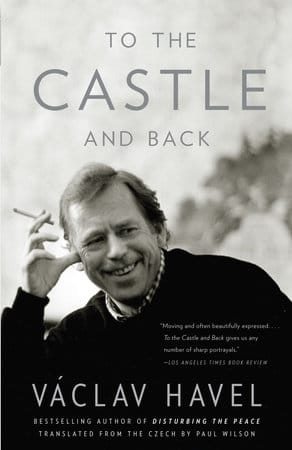
The battles against Klaus and the singular oddness of Havel's presidential style dominate his post-presidential literary output – most notably his presidential memoir, To The Castle and Back, and his play, Leaving.
To the Castle and Back is a synthetic work, blending a diary, an extended interview and a flood of presidential memos (many of them trivial). It’s an almost Dadist – and thoroughly warts and all – look at his own presidency which reflects Havel’s deep unease about the snares of power.
The play, Leaving, also possesses a synthetic feel, blending elements of King Lear and The Cherry Orchard to illuminate Havel’s own ambiguous responses to his own political life. The Shakespeare and Chekhov plays upon which Havel draws both deal with human failings of blindness, delusion and loss, so it is hard not to see Leaving as Havel’s harsh verdict on his own political impotence. The wicked inherit the future in Havel’s political universe.
Both To the Castle and Back and Leaving indulge in sharp self-mockery, not at the ideals that Havel espoused in creating revolution, but his own effectiveness in the post-revolutionary state. It’s less a burnishing of his legacy then a questioning of what he was able to accomplish with his hands on the levers of power.
What remains so magical, and so much a fairy tale, in the life of Václav Havel, is that he was the most visible representative of that generation of playwrights, philosophers, labor organizers and clergymen who managed to destroy the walls erected by Central and Eastern Europe’s totalitarian regimes.
But Havel’s clarity in dissecting his achievements and his failures is also inspiring. Dissidents do not draw inspiration from Havel’s presidency, but rather from the art and moral courage that remade his society.
Can one still remake a corrupt and repressive society with the weapons of the intellect and a fierce refusal to bend to untruth? Or was that a uniquely Bohemian fairy tale? The stakes remain high. And the answer, unclear.
Not a subscriber to Stage Write? Sign up here. It's free – and it will stay that way.